Winter is the season of the most unpredictable road conditions. Although road services do their best to clear the streets of snow and ice, heavy snowfall or a sharp drop in temperature can make the road extremely slippery in just a few minutes. No matter how many driver-assistance systems a car has, in such conditions, it is the driver’s skills that play the key role.
Basic rules for driving on ice
As soon as heavy snow falls or black ice appears, typical winter accidents like skidding or rear-end collisions start to occur quite often on city streets. In some cases, the reason is summer tires that were never replaced with winter ones (we have already talked about the importance of this and other steps in preparing your car for winter here). However, driver behavior is no less important. If you ignore the road conditions, no studs or brand-new tires will help. There are basic rules for driving on icy roads that will help you avoid such common accidents.
If you suspect the road might be slippery, follow these basic safety rules:
- Avoid sudden movements. All actions on the road should be smooth: acceleration, braking, turning, and lane changes. Remember: a heavy vehicle has huge inertia, and it is enough to cause a skid during a sudden maneuver, regardless of speed.
- Maintain a safe following distance and side clearance. This follows from the previous point: to have time to react to the actions of the car in front without abrupt maneuvers, you need to give yourself enough reaction time. If in normal conditions it is recommended to keep a distance of about 2–3 seconds of driving, then on icy roads it should be at least doubled.
- Choose a safe speed. The biggest mistake inexperienced drivers make is driving on ice or snow at the same speed as on a dry road. A safe speed in bad weather is always lower; it depends on road conditions and must allow you to retain full control of the vehicle.
- Choose a place to stop carefully. Try not to stop on a steep incline. If there is no other option (for example, you are yielding or stopping at a traffic light), find a place where at least one driven wheel has good traction with the road.
Braking rules on a slippery road
When it comes to accidents or uncontrolled skids, the most common cause is improper braking. To avoid such mistakes, remember the main rule of winter braking: under no circumstances should you allow the wheels to lock completely.
There is a very simple reason for preventing wheel lockup: as soon as the wheels stop rotating, the driver completely loses control of the vehicle. If you’ve experienced this before, you likely remember the feeling of helplessness when the car does not respond to steering input or other actions at all. As long as the wheels are turning, you maintain control, even if the road is very slippery.
Instead, follow these recommendations to stop quickly and safely:
| Rule | How to perform | Why it matters |
|---|---|---|
| Brake in pulses (“step braking”) | Press the brake → the wheels start to lock → release the pedal → repeat the cycle | Reduces stopping distance and lowers the risk of complete wheel lockup |
| Do not shift to neutral in advance | With a manual transmission, do not shift the lever to neutral before braking; release the accelerator, start braking, and only shift out of gear when the revs drop to about 1000 rpm | An engaged gear helps slow the car with the engine and improves control |
| Brake when the wheels are straight | Avoid braking in a turn; reduce speed on a straight line before entering a curve | Reduces the risk of skidding and loss of control due to inertia |
Modern cars are equipped with an anti-lock braking system (ABS), which prevents the wheels from locking completely. If your car has ABS and it is functioning properly, you can brake with a single firm press of the pedal and the system will perform the pulsed braking for you. However, you should not rely entirely on ABS: if you feel that the wheels are still locking, take control and act yourself.
Engine braking
Many experienced drivers do not rely solely on brake pads and use engine braking instead. This method slows the vehicle down more gradually, but completely eliminates the risk of wheel lockup and maintains full control over the driving situation by shifting the load to the front axle.
Engine braking is most effective on front-wheel-drive cars with a manual transmission. The process looks like this:
- You take your foot off the accelerator while staying in gear
- When the revs drop to about 1500 rpm, you depress the clutch, shift to a lower gear, and slowly release the clutch so that the transition is smooth
- You repeat this operation step by step
- If necessary, you “finish” braking with the brake pedal
How to behave in a turn
Another element of driving where you must be extremely attentive is cornering. When you turn, the force of inertia (the same one that presses us into the seat during rapid acceleration) acts in a straight line rather than along the path of the turn. To prevent this force from causing a skid, it is crucial, again, to avoid abrupt movements. In practice, this comes down to the following recommendations:
- Take turns at a slower speed than you would on a dry road.
- Avoid braking while turning unless absolutely necessary: because the wheels are turned, the risk of losing traction is much higher. Instead, reduce your speed to a safe level in advance.
- Do not turn the steering wheel too sharply. With a smooth steering angle, the shift of the inertia vector relative to the turning trajectory is less significant.
- Do not apply throttle while turning in a front- or rear-wheel-drive car. Such actions can provoke a skid.
To maintain better traction, pay attention to the condition of the road surface. Some sections may be well treated with de-icing chemicals. In such cases, try to steer so that your trajectory passes through these sections.
What to do in a skid
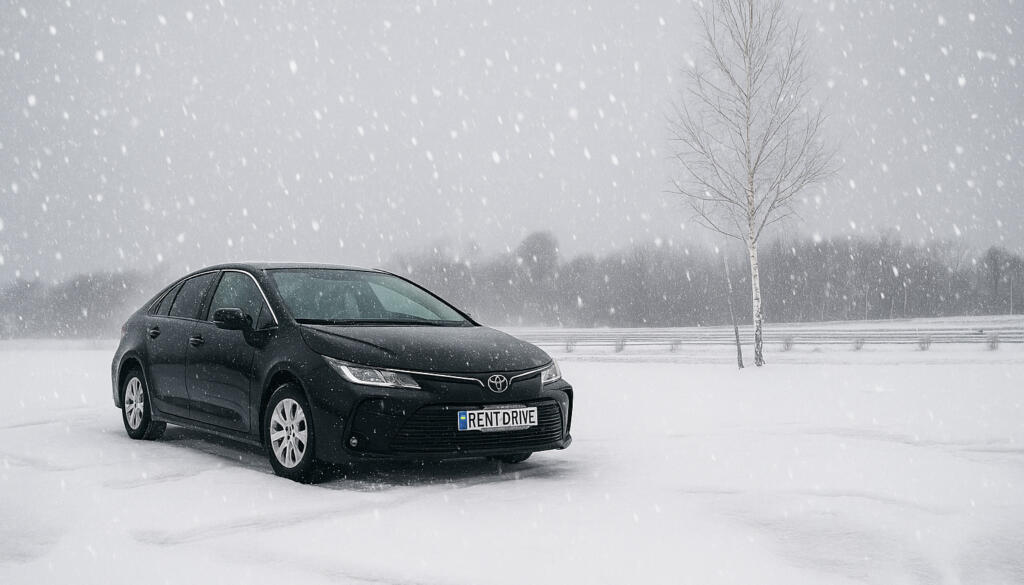
Even if the driver does everything right, road conditions or the actions of other road users can still cause a skid. This term refers to an unintended deviation of the vehicle’s trajectory from the one set by the driver. Loss of control can trigger panic, but the correct actions will help you quickly straighten the car without ending up in a ditch.
The wheels have already lost grip with the surface, and if they lock, you will also lose the ability to influence the trajectory with the steering wheel. To prevent the skid from worsening, you need to take your foot off the brake pedal. There is no need to shift out of gear.
To recover from a skid, you should:
- Turn the steering wheel in the direction of the skid: if the rear end slides to the right, you should also turn the front wheels to the right. This will stop the car from rotating and restore traction with the surface.
- For a front-wheel-drive car: gently apply the accelerator so that the front wheels “pull” the rear axle out of the skid.
- For rear-wheel-drive and all-wheel-drive cars: reduce engine speed or completely lift your foot off the accelerator, allowing the car to straighten out smoothly.
A properly functioning braking system is your reliable ally, helping you feel confident even on icy roads. Service your own vehicle regularly or choose a dependable car from the RentDrive car rental, and your winter journeys will bring you nothing but pleasant impressions.